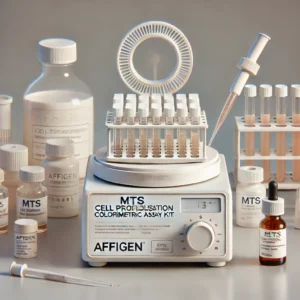
The MTS Cell Proliferation Colorimetric Assay Kit by AffiGEN is a widely used and reliable method for measuring cell viability and proliferation. This non-radioactive, colorimetric assay is based on the reduction of the MTS tetrazolium compound into a soluble formazan product by metabolically active cells. The intensity of the color produced correlates directly with the number of viable cells in a population, making it an essential tool in cell biology, toxicology, and drug discovery.
How the MTS Cell Proliferation Assay Works
The MTS assay relies on the reduction of the MTS compound by NAD(P)H-dependent enzymes present in metabolically active cells. The process leads to the formation of a colored, water-soluble formazan product that can be quantified using a microplate reader. The key steps of the assay include:
- Cell Seeding: Cells are seeded into a 96-well plate and allowed to adhere and grow.
- Addition of MTS Reagent: The MTS reagent is added to each well.
- Incubation: Cells are incubated with the reagent, allowing viable cells to convert the MTS into a formazan product.
- Measurement: After incubation, the absorbance of the formazan product is measured at 490 nm using a microplate reader. The absorbance is proportional to the number of viable cells in the sample.
Applications of the MTS Cell Proliferation Assay Kit
- Cell Proliferation Studies: The MTS assay is frequently used to assess cell growth and proliferation rates under different conditions, such as treatment with growth factors or inhibitors. According to NIH, the assay is highly sensitive and reproducible, making it ideal for quantifying cell proliferation.
- Cytotoxicity Testing: One of the primary applications of the MTS assay is in toxicology for evaluating the cytotoxic effects of chemicals, drugs, and environmental factors on cell populations. The assay provides a rapid and accurate means of determining cell viability after exposure to test substances, as highlighted by PubMed Central (PMC).
- Drug Discovery and Screening: The MTS assay is an indispensable tool in high-throughput screening (HTS) for identifying compounds that affect cell viability or proliferation. The FDA notes that colorimetric assays like MTS are commonly employed in the pharmaceutical industry to assess the potential cytotoxic effects of new drug candidates.
- Cancer Research: In cancer biology, the MTS assay is used to measure the proliferation rates of cancer cells in response to chemotherapeutic agents or other treatments. Research published by Johns Hopkins University has shown that the MTS assay is a valuable tool for studying cancer cell survival and treatment efficacy.
Advantages of the MTS Cell Proliferation Assay Kit by AffiGEN

- Non-Radioactive: Unlike traditional cell proliferation assays that use radioactive materials (e.g., MTT assay), the MTS assay is a safer alternative, eliminating the need for hazardous materials handling and disposal.
- Simplified Workflow: The MTS assay involves fewer steps than other tetrazolium assays, such as MTT. Since the formazan product is soluble, there is no need for an additional solubilization step, simplifying the protocol and reducing assay time.
- High Sensitivity: The MTS assay provides high sensitivity, detecting even small changes in cell viability. This is especially useful for applications like drug screening, where detecting subtle cytotoxic effects is crucial.
- Versatility: The MTS assay is compatible with various cell types, including adherent and suspension cells, making it a versatile option for multiple research areas, as noted by NIH.
- Cost-Effective: The assay is cost-effective for high-throughput applications, with large-scale screening in 96-well or 384-well plate formats. This makes it an ideal choice for large-scale cytotoxicity testing or drug discovery experiments, as outlined by the FDA.
Practical Considerations and Limitations
- Incubation Time: The length of the incubation period with the MTS reagent can vary depending on cell type and density. Optimizing the incubation time is essential to obtain accurate results, as mentioned by Harvard University.
- Interference with Reducing Agents: Compounds that interact with cellular reducing pathways can interfere with the MTS assay results. Researchers should validate their experimental design to minimize potential interference.
- Plate Reader Calibration: Proper calibration of the microplate reader is essential to ensure accurate quantification of the formazan product. Absorbance measurements should be taken within a specific range to avoid potential inaccuracies.

Conclusion
The MTS Cell Proliferation Colorimetric Assay Kit by AffiGEN is a powerful, reliable, and safe tool for measuring cell viability and proliferation in a wide range of applications, including toxicology, drug screening, and cancer research. Its ease of use, combined with high sensitivity and non-radioactive nature, makes it a preferred choice for both academic and industrial research.
As noted by NIH and FDA, assays like MTS are crucial for advancing our understanding of cellular responses to various stimuli, contributing significantly to the fields of molecular biology, biotechnology, and pharmaceutical development.