
Veterinary Rapid Tests are essential diagnostic kits designed to provide fast and accurate results for animal diseases directly in the field or at clinics. These tests detect pathogens, antigens, or antibodies in animal samples using immunochromatographic lateral flow technology. They play a vital role in disease surveillance, livestock monitoring, and zoonotic infection control, contributing to both animal welfare and agricultural productivity.
Veterinary diagnostic testing is increasingly important as farms, laboratories, and veterinary centers seek rapid detection methods that can support decisions in real time. By integrating modern immunoassay engineering, nanoparticle labeling, and portable data readers, these rapid tests deliver results within minutes without requiring specialized instruments or technical expertise.

Principle and Scientific Basis of Veterinary Rapid Tests
The working principle of a Veterinary Rapid Test Kit is based on antibody-antigen recognition—a specific and sensitive biochemical interaction that can detect minute concentrations of pathogens or biomarkers. The test strip typically contains:
-
Sample pad for absorbing biological specimens.
-
Conjugate pad loaded with antibodies labeled with gold nanoparticles or latex beads.
-
Nitrocellulose membrane with immobilized capture antibodies forming the test and control lines.
-
Absorbent pad to ensure capillary flow and waste collection.
When a biological sample (blood, serum, plasma, feces, urine, saliva, or milk) is applied, it flows along the membrane by capillary action. If the target analyte is present, antigen-antibody complexes form and generate visible colored lines.
This lateral flow immunoassay (LFA) technology is well-documented in various veterinary research studies (ncbi.nlm.nih.gov, nih.gov, fda.gov).
Common Pathogens Detected by Veterinary Rapid Tests
Veterinary Rapid Tests can detect a broad range of viral, bacterial, and parasitic pathogens that affect both domestic and farm animals. Examples include:
-
Canine Parvovirus (CPV) (cdc.gov)
-
Canine Distemper Virus (CDV) (usda.gov)
-
Feline Leukemia Virus (FeLV) and Feline Immunodeficiency Virus (FIV) (nih.gov)
-
Brucella spp. in cattle, goats, and sheep (aphis.usda.gov)
-
Avian Influenza Virus (AIV) (fao.org)
-
Foot and Mouth Disease Virus (FMDV) (woah.int)
-
African Swine Fever Virus (ASFV) (usgs.gov)
-
Mycoplasma spp., Ehrlichia, and Anaplasma in livestock and pets (cdc.gov/ticks)
Each test is engineered to provide species-specific accuracy, high analytical sensitivity, and minimal cross-reactivity with other pathogens.
Technological Improvements in Veterinary Test Kit Design
Modern Veterinary Rapid Tests now incorporate advanced biotechnological features for enhanced detection performance. Some of the main innovations include:
-
Nanogold labeling and quantum dot markers for improved signal amplification.
-
Dual and multiplex strip designs to detect multiple pathogens in one test.
-
Digital and smartphone-based readers that interpret line intensity with quantitative precision.
-
Stabilized reagents using lyophilization and polymer encapsulation to ensure temperature resistance in field conditions.
-
Biocompatible membranes that reduce background noise and improve line sharpness (nist.gov).
Researchers at universities such as Cornell University College of Veterinary Medicine (cornell.edu) and University of California, Davis (ucdavis.edu) continue to develop microfluidic-based diagnostic chips and AI-supported analyzers for faster and more accurate interpretation.
Field Applications of Veterinary Rapid Tests
Companion Animal Testing
Veterinary clinics use rapid test kits for canine and feline diseases such as:
-
Canine Heartworm (Dirofilaria immitis)
-
Canine Ehrlichia/Anaplasma Combo Tests
-
Feline Coronavirus (FCoV)
-
Feline Panleukopenia Virus (FPV)
These tests provide accurate differential diagnosis and assist veterinarians in monitoring disease prevalence in urban and shelter populations.
Livestock Health Surveillance
For farm management and trade certification, rapid tests detect key diseases including:
-
Brucellosis and Bovine Viral Diarrhea (BVDV)
-
Porcine Reproductive and Respiratory Syndrome (PRRS)
-
Peste des Petits Ruminants (PPR)
-
Leptospirosis and Trypanosomiasis
Rapid diagnosis minimizes economic loss, improves animal productivity, and supports biosecurity measures mandated by agricultural authorities (usda.gov, fao.org).
Avian and Aquatic Applications
The poultry industry depends on Avian Influenza, Newcastle Disease, and Infectious Bursal Disease rapid tests to prevent outbreaks. Similarly, fish farms use Koi Herpesvirus (KHV) and Vibrio test kits for aquatic biosecurity.
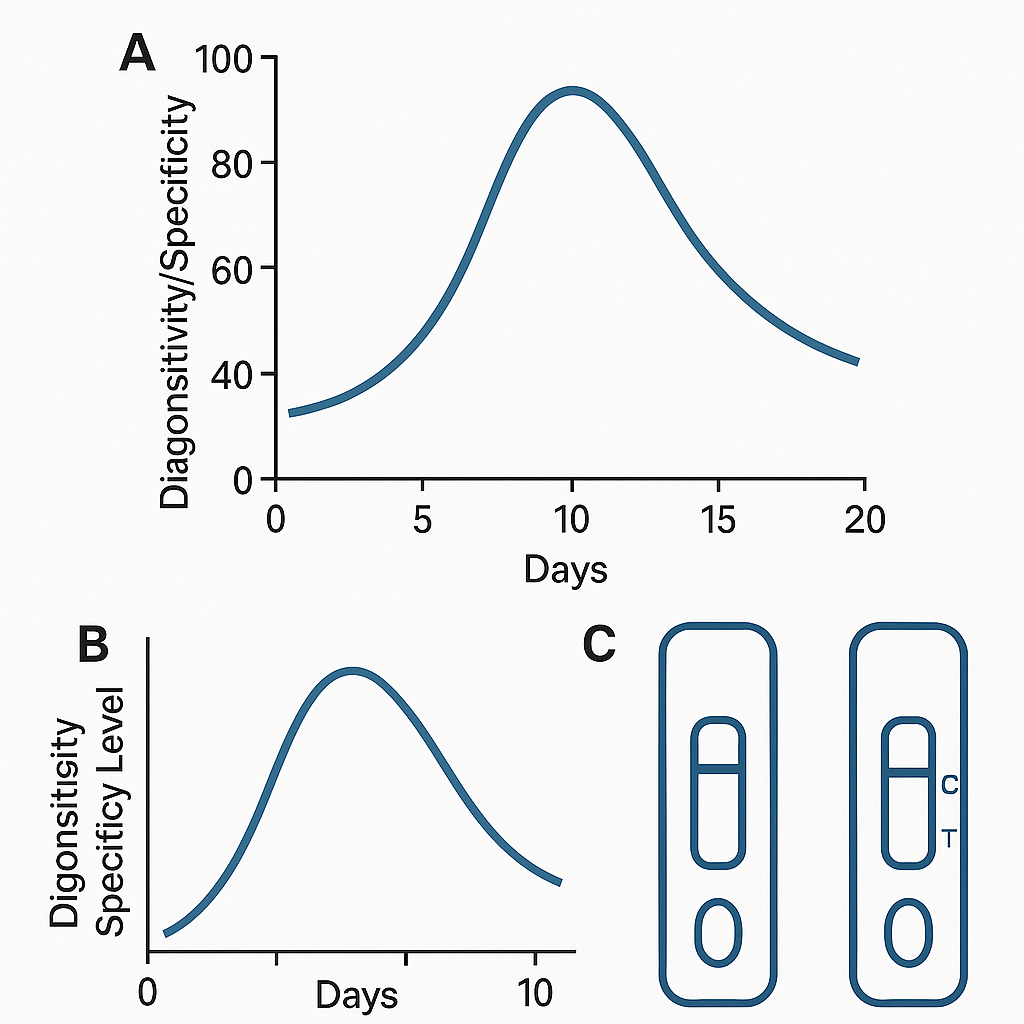
Performance Parameters and Quality Indicators
To ensure reliability, Veterinary Rapid Tests are evaluated by recognized institutions like USDA-APHIS, OIE/WOAH, and ISO-accredited laboratories (woah.int, fda.gov). Critical validation criteria include:
-
Sensitivity (%) and Specificity (%)
-
Positive Predictive Value (PPV) and Negative Predictive Value (NPV)
-
Coefficient of Variation (CV%) for batch reproducibility
-
Limit of Detection (LoD) for low antigen concentrations
-
Temperature and humidity stability under transport conditions
Standard reference methods like ELISA, qPCR, and Western blot are used for test correlation and validation (ncbi.nlm.nih.gov).
Importance in Biosecurity and Zoonotic Disease Prevention
Veterinary Rapid Tests are integral to the One Health initiative linking animal, human, and environmental health systems (who.int).
Early detection of zoonotic pathogens such as Brucella, Leptospira, or Influenza viruses helps prevent transmission between species and reduces global health risks.
Regulatory programs by USDA, CDC, and FAO promote the use of validated field diagnostics for surveillance, trade certification, and outbreak control (cdc.gov, usda.gov, fao.org).
Manufacturing Standards and Storage Requirements
Manufacturers of Veterinary Rapid Tests must comply with ISO 9001, ISO 13485, and GMP guidelines for medical devices.
Each batch undergoes rigorous performance verification, including tests for shelf-life, cross-reactivity, precision, and stability.
Storage guidelines typically recommend:
-
Keep at 2–30°C, away from direct sunlight.
-
Do not freeze test strips.
-
Use within 18–24 months from manufacturing.
-
Avoid moisture exposure after foil opening.
Governmental resources like FSIS (fsis.usda.gov) and NIST (nist.gov) provide calibration standards for reproducibility and analytical verification.
Integration with Digital and Smart Platforms
Recent advances in digital veterinary diagnostics include mobile reader devices that connect via Bluetooth or Wi-Fi to automatically record and interpret test results.
Data can be uploaded to centralized platforms for epidemiological mapping and real-time tracking of animal disease outbreaks (usgs.gov).
This integration supports precision livestock farming, helping veterinarians and researchers make data-driven health decisions.
Environmental Sustainability and Waste Management
Modern Veterinary Rapid Tests are designed with biodegradable plastic components and low-toxicity reagents to minimize ecological impact.
Regulated waste disposal guidelines from the Environmental Protection Agency (EPA) (epa.gov) ensure proper management of used diagnostic materials and packaging waste, reducing environmental footprint.
Global Veterinary Diagnostic Market Perspective
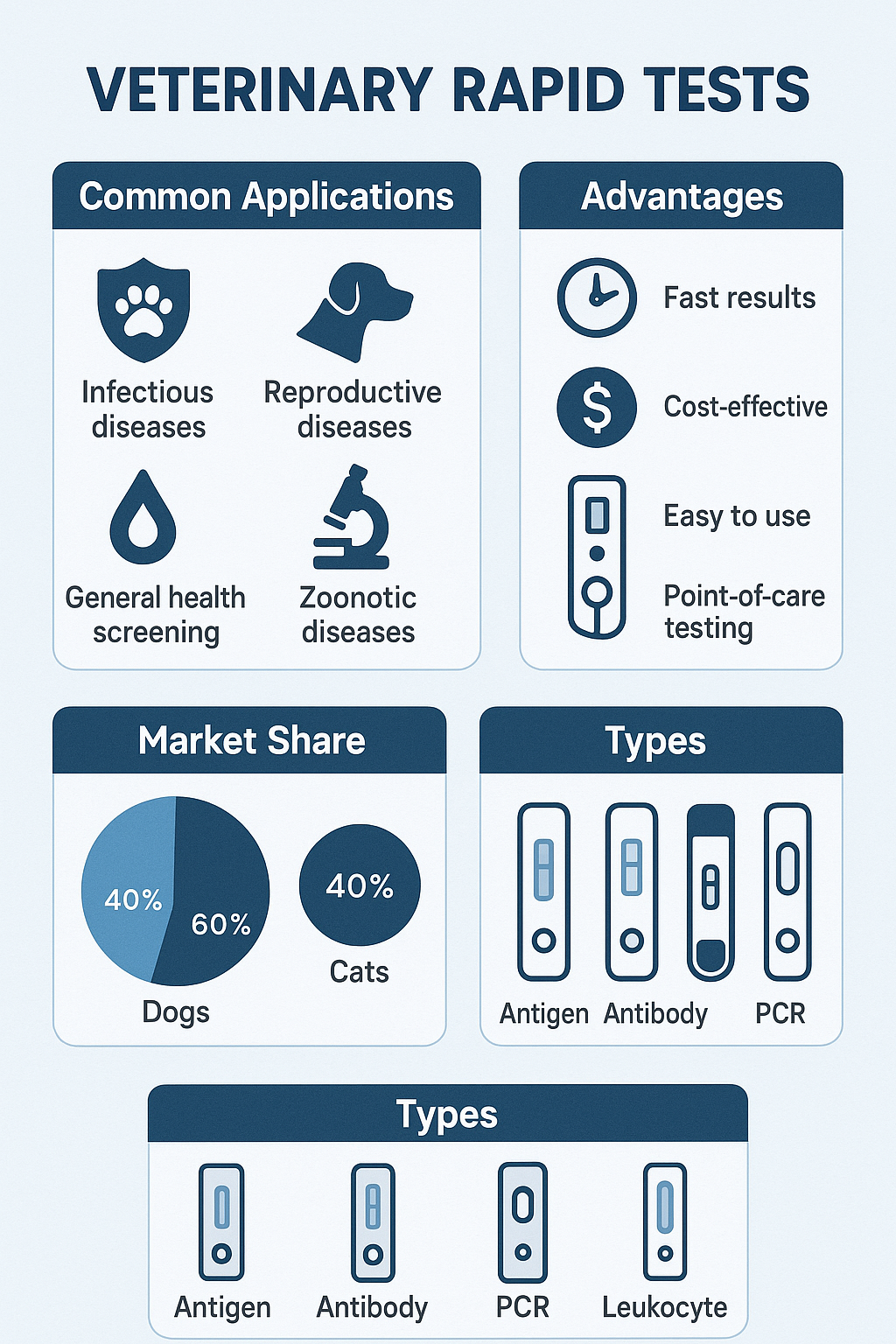
According to data from USDA, WOAH, and FAO, the global veterinary rapid test market continues to expand due to:
-
Growth in pet ownership and livestock production.
-
Increased focus on zoonotic disease prevention.
-
Advancements in point-of-care diagnostic systems.
-
Government programs for animal disease surveillance and vaccination monitoring.
The introduction of multiplex veterinary panels and AI-supported readers enhances both efficiency and scalability in diagnostic laboratories.
Educational and Research Contributions
Academic centers such as:
are leading in validation, performance comparison, and proficiency testing for new rapid test formats, ensuring continuous development and scientific credibility.
Conclusion: The Future of Veterinary Rapid Tests
Veterinary Rapid Tests represent a cornerstone technology in animal disease management, offering unparalleled speed, simplicity, and accuracy.
Future innovations will focus on multiplex digital readers, biosensor miniaturization, and AI-assisted diagnostics to make animal health testing more accessible and precise across global environments.
These tests enable a new era of smart veterinary diagnostics, integrating biotechnology, nanoscience, and data analytics to safeguard animal populations and support sustainable agriculture worldwide.
Veterinary Rapid Tests provide quick, accurate, and portable detection of animal diseases. Learn how these lateral flow assay kits improve biosecurity, livestock management, and global veterinary diagnostics.
veterinary rapid tests, animal disease detection, lateral flow assay, veterinary diagnostic kits, animal health testing, rapid antigen test, livestock disease test, point-of-care veterinary test, field diagnostics, animal biosecurity, veterinary ELISA comparison, antigen antibody test for animals, veterinary test kit supplier, veterinary pathogen detection, portable veterinary assays.