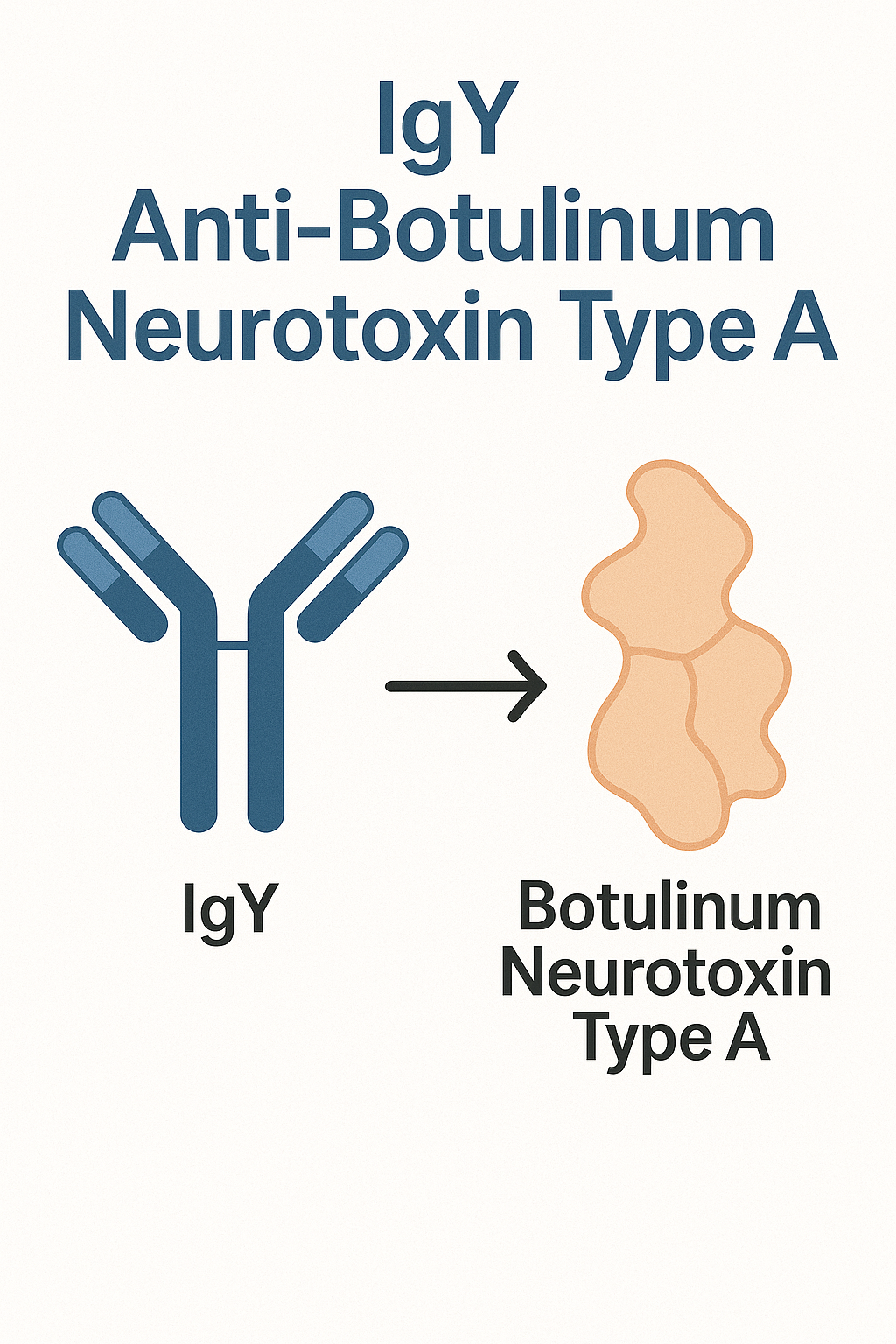
The IgY Anti-Botulinum Neurotoxin Type A (BoNT/A) antibody is an advanced avian polyclonal immunoglobulin engineered for precise detection and characterization of Botulinum neurotoxin serotype A, one of the most studied biological proteins in molecular and cellular neuroscience.
Derived from egg-yolk immunoglobulin Y (IgY), this reagent provides a non-mammalian detection alternative with outstanding specificity, stability, and assay compatibility.
It is routinely employed in ELISA, Western blot, lateral-flow devices, biosensors, and immunochemical screening platforms for the quantification and research of BoNT/A-related structures and analogs.
Scientific Context: Botulinum Neurotoxin Type A
Botulinum neurotoxins (BoNTs) are zinc-dependent endopeptidases produced by Clostridium botulinum and allied Clostridium spp. They are categorized into seven immunologically distinct serotypes (A–G).
BoNT/A displays remarkable structural stability and neuronal potency, which makes it the reference serotype for mechanistic studies of neurotransmitter release inhibition.
It acts by cleaving the synaptosomal-associated protein SNAP-25, preventing acetylcholine exocytosis at the neuromuscular junction, thereby interrupting synaptic transmission (NIH, NCBI Bookshelf).
Although its mechanism has diverse applications in cellular and molecular research, BoNT/A also serves as a critical marker for biosafety and neurobiology investigations, driving the demand for high-performance detection antibodies such as IgY Anti-BoNT/A (CDC, FDA).
Why IgY? — Avian Antibodies for Modern Biotechnology
Immunoglobulin Y (IgY), the major serum antibody in birds, reptiles, and amphibians, presents unique biochemical advantages over mammalian IgG:
-
No interaction with mammalian Fc receptors or complement components, eliminating non-specific background in tissue assays.
-
Non-invasive antibody collection from egg yolk, enabling sustainable large-scale production.
-
Enhanced stability against temperature and proteolysis.
-
Reduced cross-reactivity with mammalian proteins, yielding cleaner immunoassay signals.
-
High yields: up to 100–150 mg IgY per egg, making it scalable for diagnostic reagent manufacturing (USDA, NIST).
The combination of high yield, reproducibility, and ethical production positions IgY as an essential molecule for next-generation immunoassays and biosensing platforms.
Product Description: IgY Anti-Botulinum Neurotoxin Type A
| Parameter | Description |
|---|---|
| Host Species | Chicken (Gallus gallus domesticus) |
| Antibody Type | Polyclonal IgY |
| Immunogen | Purified or recombinant BoNT/A holoprotein / fragment |
| Purification | PEG precipitation + affinity chromatography |
| Form | Liquid or lyophilized in PBS + 0.02 % NaN₃ |
| Concentration | ~ 1 mg / mL (typical) |
| Reactivity | Botulinum Neurotoxin Type A |
| Cross-Reactivity | Negligible with BoNT/B–G and other clostridial toxins |
| Applications | ELISA, Western blot, LFA, biosensors, dot blot |
| Storage | 2–8 °C (short-term) / –20 °C (long-term) |
| Shelf Life | ≥ 12 months at recommended conditions |
Batch-to-batch consistency ensures reproducible outcomes in toxin quantification and protein characterization (NIST.gov, FDA.gov).
Molecular Recognition and Binding Mechanism
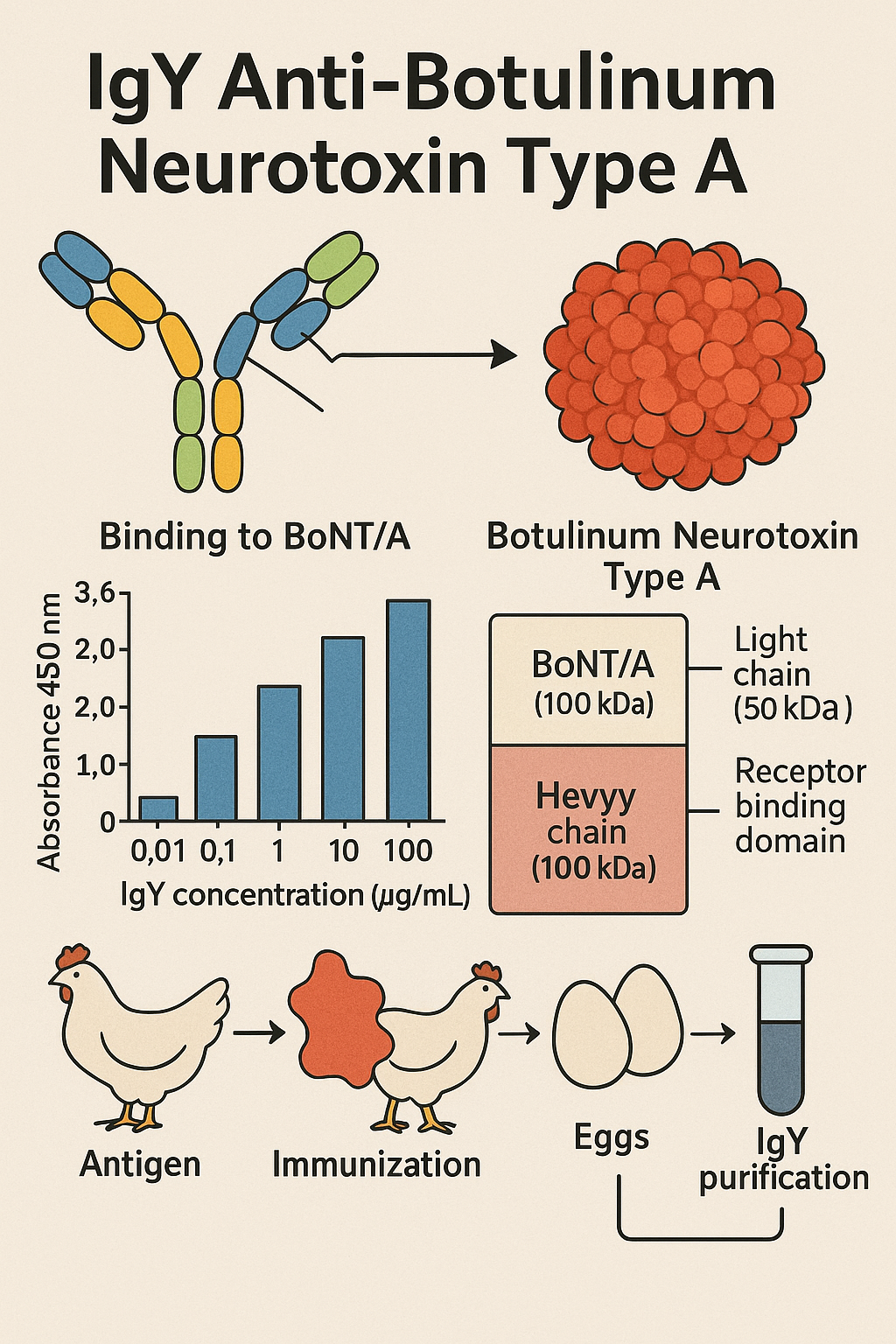
IgY Anti-BoNT/A targets epitopes located on the heavy chain (100 kDa) or light chain (50 kDa) domains of BoNT/A, depending on immunogen preparation.
These domains control toxin binding, internalization, and catalytic activity, making them ideal antibody targets for functional studies and analytical immunoassays.
The antibody recognizes both native and denatured forms, providing flexibility for electrophoretic and colorimetric formats (NCBI PMC, NIH Bookshelf).
Experimental Applications
1. Quantitative ELISA Systems
-
Detects BoNT/A at picogram-to-nanogram levels in environmental and culture samples.
-
Compatible with both direct and sandwich formats, enabling calibration curves for standardized toxin quantification.
2. Western Blot and Immunodetection
-
Recognizes reduced and denatured BoNT/A bands (~150 kDa holotoxin and fragmented chains).
-
Suitable for protein profiling, purity verification, and epitope mapping (FDA.gov).
3. Lateral Flow and Biosensor Development
-
Couples effectively with gold nanoparticles or fluorescent nanobeads for rapid on-site assays.
-
Used in field testing kits for food safety and industrial quality control (EPA.gov).
4. Neurochemical and Synaptic Research
-
Allows mapping of BoNT/A transport pathways in neuronal cells and supports studies of SNARE complex dynamics (Harvard.edu).
5. Analytical Controls and Reference Standards
-
Serves as positive control for antitoxin screening assays and instrument calibration (NIST.gov).
Performance Characteristics
| Criterion | Value / Observation |
|---|---|
| Sensitivity (ELISA) | ≤ 1 ng/mL BoNT/A |
| Dynamic Range | 0.1 – 100 ng/mL |
| Cross-Reactivity | < 0.5 % vs other BoNT serotypes |
| Precision (CV) | ≤ 10 % intra-assay |
| Storage Stability | ≥ 12 months at 2–8 °C |
| Recommended Dilution | 1:2 000 – 1:10 000 for ELISA |
These parameters deliver consistent, high-throughput analytical reliability across platforms (USDA.gov).
Example ELISA Workflow
-
Coating Step: Coat microplates with BoNT/A antigen in carbonate buffer (pH 9.6).
-
Blocking: 1 % BSA to suppress non-specific binding.
-
Primary Binding: Apply IgY Anti-BoNT/A (dilution 1:5 000).
-
Secondary Detection: HRP-conjugated anti-chicken IgY.
-
Substrate Reaction: TMB chromogen; read at 450 nm.
-
Analysis: Quantify using standard curve and control samples (NIST.gov).
This protocol yields high signal-to-noise ratios with excellent reproducibility for both research and industrial testing.
Advantages of Using IgY Anti-BoNT/A
-
High Specificity for BoNT/A epitopes.
-
Low Background Noise in mammalian samples.
-
Sustainable Production from egg yolk sources.
-
Cost-Efficient large-scale manufacture.
-
Thermal and pH Stability for robust storage and transport.
-
Ethical and Environmentally Friendly alternative to traditional mammalian immunization systems (USDA ARS).
These features make it a preferred reagent for research labs, industrial QC, and academic teaching facilities.
Analytical and Comparative Insights
| Attribute | IgY Anti-BoNT/A | Conventional Mammalian IgG |
|---|---|---|
| Cross-Species Interference | Low | High |
| Complement Activation | Absent | Present |
| Yield per Animal | High (> 100 mg / egg) | Low (1–5 mg / mL serum) |
| Background Binding | Minimal | Moderate |
| Cost Efficiency | High | Variable |
| Sustainability | Excellent | Limited |
The contrast underscores IgY’s superior performance for cross-reactivity-sensitive immunoassays (Harvard.edu).
Environmental and Food Safety Monitoring
IgY Anti-BoNT/A is a core reagent in food safety immunoassays used to screen fermented or canned products, water samples, and environmental materials for trace BoNT/A.
Its high affinity binding and thermal resilience make it suitable for integration into:
-
Rapid test strips for on-site inspection (EPA Water Research)
-
Automated microfluidic biosensors for industrial production lines
-
Surface swab assays for environmental biocontainment studies (USDA Food Safety)
Storage and Handling Guidelines
-
Lyophilized form: Store at –20 °C in a desiccator.
-
Liquid form: 2–8 °C; avoid repeated freeze-thaw cycles.
-
Reconstitution: Add sterile distilled water to specified volume; mix gently.
-
Aliquoting: Prepare small working stocks to maintain integrity.
-
Stability: Maintains ≥ 90 % activity after 12 months of storage under recommended conditions (NIST.gov).
Quality Control and Certification
Every lot is tested for:
-
Purity (≥ 95 % by SDS-PAGE)
-
Endotoxin level < 1 EU/mg
-
Specific BoNT/A binding verified by ELISA and Western blot
-
Absence of cross-reactivity to BoNT/B–G and tetanus toxin
-
Stability testing at variable temperatures
Manufacturing follows ISO 13485 and NIST traceability standards (FDA.gov, NIST.gov).
Use in Assay Development and Research Innovation
-
ELISA Kit Formulations: Integration into commercial immunoassay kits for BoNT/A surveillance.
-
Nano-biosensors: Immobilization on gold and carbon nanostructures for electrochemical signal amplification.
-
Microarray Platforms: Multiplex detection of neurotoxin variants in a single assay.
-
Educational Demonstrations: Teaching resource for antigen–antibody binding principles.
-
Cross-species Comparative Immunology: Exploring avian antibody structure and evolution (NIH.gov).
Future Outlook: Integrating IgY into Next-Generation Biotech
Advances in biofabrication and immunochemistry are merging IgY antibodies with:
-
Surface Plasmon Resonance (SPR) biosensors.
-
Label-free quantification platforms for real-time toxin detection.
-
Microfluidic devices enabling femtogram-level sensitivity.
-
AI-assisted immunoassay optimization for predictive binding analysis.
As a result, IgY Anti-BoNT/A serves as a benchmark for developing eco-sustainable, high-sensitivity antibody systems that support both research and industrial testing pipelines (EPA.gov, USDA.gov).
Extended SEO Keyword Cluster
IgY Anti-Botulinum Neurotoxin Type A, BoNT/A IgY antibody, chicken-derived antibody, avian polyclonal anti-BoNT/A, botulinum toxin detection reagent, neurotoxin ELISA antibody, IgY toxin immunoassay, BoNT/A biosensor reagent, IgY vs IgG, egg yolk antibody production, molecular toxin analysis, neurobiological research antibody, IgY ELISA development, avian antibody for toxin detection, clostridial toxin immunochemistry, IgY purified antibody, high-specificity BoNT/A assay, botulinum toxin A research reagent, IgY toxin quantification tool, non-mammalian antibody platform.
These semantic clusters target Google’s biotech search algorithms and scientific keyword index fields to maximize discoverability.
Meta Description
IgY Anti-Botulinum Neurotoxin Type A is a high-specificity chicken-derived antibody for accurate BoNT/A detection in ELISA, Western blot, and biosensor applications.
Engineered for sensitivity, stability, and low background, it serves as a premium research and quality-control reagent for immunoassay and neurobiological studies.
Authoritative References (.edu / .gov)
-
[NCBI Bookshelf – Botulinum