Traditional cloning and TA cloning reagents remain the essential building blocks of molecular biology, even in the age of automated DNA synthesis and seamless cloning technologies. These systems continue to offer researchers a cost-effective, high-fidelity, and adaptable means of creating recombinant DNA constructs, subcloning PCR fragments, or generating expression plasmids for functional studies.
Whether used in bacterial transformation, genomic mapping, or synthetic biology, high-quality TA and traditional cloning reagents ensure every ligation and transformation step maintains reproducibility, accuracy, and efficiency.

Introduction to Traditional and TA Cloning
What Is Traditional Cloning?
Traditional cloning relies on the use of restriction endonucleases and DNA ligase to cut and join DNA molecules. Restriction enzymes recognize specific palindromic sequences in both the vector and insert DNA, producing either sticky (cohesive) or blunt ends. These complementary ends are then ligated by T4 DNA ligase to form a recombinant plasmid ready for propagation in a bacterial host.
This technique forms the foundation of classical molecular biology research, and despite the emergence of advanced systems, remains the gold standard for insert orientation control and precise vector design (NIH, NCBI).
What Is TA Cloning?
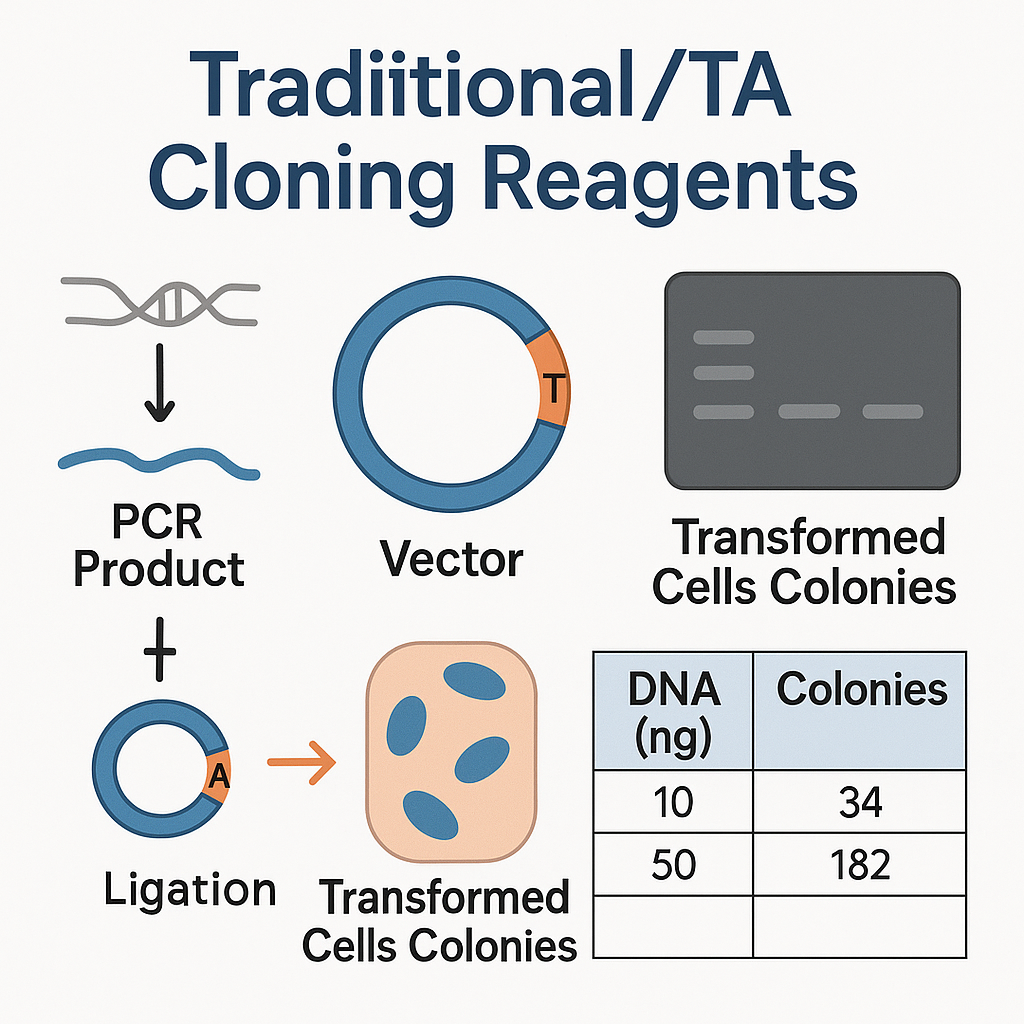
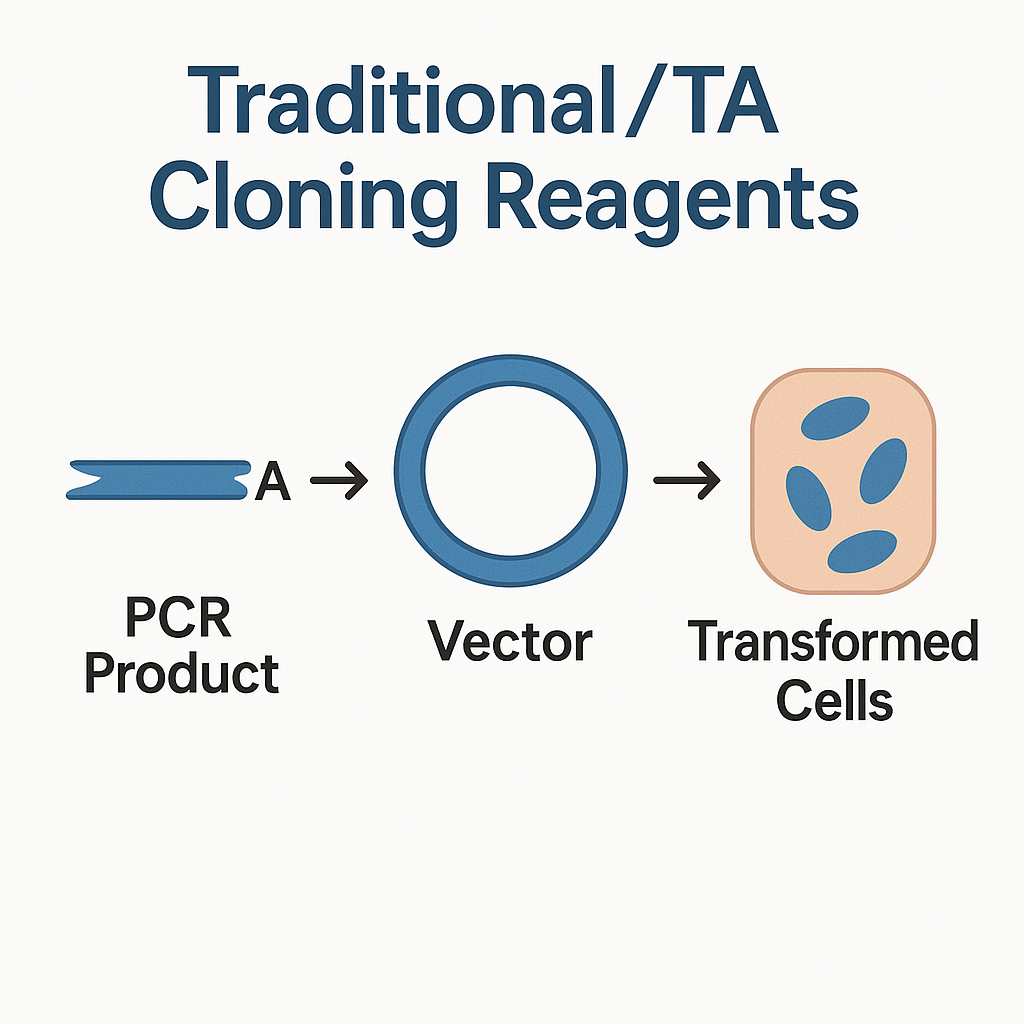
TA cloning provides a rapid and enzyme-free alternative to traditional restriction/ligation approaches. The method takes advantage of the terminal transferase activity of Taq DNA polymerase, which adds a single adenine (A) residue to the 3′ ends of PCR products.
Vectors engineered with complementary thymine (T) overhangs (T-vectors) pair naturally with these PCR products through A/T base pairing, enabling direct ligation using T4 DNA ligase (NCBI Bookshelf, NIST).
The simplicity of TA cloning makes it ideal for gene discovery, PCR validation, and small-scale subcloning, especially when researchers need a fast turnaround for sequence confirmation.
Composition of a Complete Cloning Workflow
| Reagent Type | Role in Workflow |
|---|---|
| Restriction Enzymes | Create site-specific DNA fragments |
| T4 DNA Ligase | Catalyzes phosphodiester bond formation |
| TA Cloning Vectors | Carry 3′-T overhangs for A-tailed PCR products |
| High-Fidelity Polymerases | Generate blunt or A-tailed inserts |
| dNTP Mix | Supplies nucleotides for PCR amplification |
| Competent Cells (E. coli DH5α / TOP10) | Accept recombinant plasmids |
| Buffers & ATP Solutions | Maintain optimal reaction chemistry |
| Positive Control DNA | Validates ligation and transformation efficiency |
| Antibiotic Selection Plates | Enable screening of successful clones |
| Gel Extraction or PCR Purification Kits | Clean up DNA before ligation |
Each reagent contributes to the reliability and consistency of cloning outcomes. Substandard reagents can lead to failed ligations, low colony yield, or insert orientation errors.
Traditional Cloning Mechanism Step by Step
-
Restriction Digestion: The vector and insert DNA are cleaved with restriction enzymes to generate compatible ends.
-
Purification: Gel extraction eliminates unwanted fragments or enzyme contaminants.
-
Ligation: T4 DNA ligase joins compatible ends in the presence of ATP and a buffered environment.
-
Transformation: The ligated plasmid is introduced into chemically competent or electrocompetent E. coli.
-
Screening: Blue-white screening, antibiotic selection, or colony PCR confirms positive recombinants.
This method ensures directional cloning and multiple-fragment assembly, particularly in expression or reporter plasmid design (USDA, Harvard.edu).
TA Cloning Mechanism Step by Step
-
PCR Amplification: Taq polymerase extends the DNA fragment while adding a 3′-A overhang.
-
Vector Preparation: TA vector containing complementary T overhangs is linearized and purified.
-
Ligation: T4 DNA ligase links A/T-paired ends under optimized reaction conditions.
-
Transformation: Recombinant plasmid is introduced into competent E. coli cells.
-
Screening and Verification: Colonies are verified by restriction analysis or sequencing (Johns Hopkins University, NIH Bookshelf).
TA cloning’s minimal setup makes it an indispensable tool for rapid gene capture and cloning of unknown or uncharacterized PCR fragments.
Traditional vs TA Cloning: A Comparative Perspective
| Parameter | Traditional Cloning | TA Cloning |
|---|---|---|
| Requirement for Restriction Sites | Yes | No |
| Overhang Type | Cohesive / Blunt | A/T Overhangs |
| Directionality | Directional if dual enzymes used | Non-Directional |
| Complexity | Moderate | Low |
| Time to Results | 12–24 hours | 4–6 hours |
| Applications | Precise subcloning & vector construction | Fast PCR fragment insertion |
| Cost Efficiency | Moderate | Very High |
For laboratories performing routine gene verification or small-scale cloning, TA cloning offers unmatched speed and convenience, while traditional restriction/ligation cloning remains optimal for expression systems and multi-gene constructs (NCBI PMC).
Molecular Basis of TA Cloning
During PCR, Taq DNA polymerase—a thermostable enzyme isolated from Thermus aquaticus—adds a non-templated adenine (A) residue to the 3′ ends of newly synthesized DNA fragments.
When exposed to a plasmid vector with complementary thymine (T) overhangs, these bases form A–T hydrogen bonds, allowing T4 DNA ligase to seal the sugar-phosphate backbone, resulting in a stable circular recombinant plasmid (NIH, CDC).
This biochemical simplicity enables efficient non-enzymatic cloning of PCR fragments without the need for restriction digestion, making TA cloning the preferred choice for rapid DNA fragment insertion workflows.
Optimization Strategies for Maximum Ligation Efficiency
-
Maintain Optimal Insert-to-Vector Ratios: Typical molar ratios range from 1:3 to 1:5.
-
Purify PCR Products: Eliminate residual salts, dNTPs, and polymerase inhibitors using spin-columns.
-
Use Freshly Prepared DNA Ends: Overhangs may degrade with storage.
-
Incubate Ligations at 16 °C Overnight: Improves ligation efficiency.
-
Verify Competent Cell Efficiency: ≥ 1 × 10⁸ cfu/µg DNA recommended.
-
Screen Multiple Colonies: Insert orientation in TA cloning is random; verify by digestion or sequencing.
Standardized ligation conditions ensure reproducibility in cloning workflows (FDA, NIST).
Applications Across Research Disciplines
1. Gene Cloning and Expression
Used for producing recombinant proteins, fusion tags, and functional gene studies in E. coli, yeast, or mammalian systems (NIH Office of Research Infrastructure).
2. Mutagenesis and Sequence Verification
Researchers insert point-mutated or truncated genes for protein structure–function analyses.
3. Functional Genomics and Synthetic Biology
TA cloning simplifies the assembly of gene libraries, reporter constructs, and biosynthetic pathways (EPA.gov).
4. Educational and Training Applications
University laboratories routinely use TA cloning kits for teaching recombinant DNA concepts (Harvard T.H. Chan School of Public Health).
5. Agricultural and Environmental Biotech
Traditional cloning enables transgene insertion into plant or microbial vectors, supporting crop improvement and bioremediation research (USDA ARS).
Typical Composition of TA Cloning Reagent Kits
-
T4 DNA Ligase + 10× Reaction Buffer
-
Linearized TA Vector (3′-T Overhangs)
-
dNTP Mix (10 mM each)
-
Positive Control Insert DNA
-
Competent E. coli Cells (DH5α, JM109)
-
Blue-White Screening Reagents (IPTG/X-Gal)
-
Antibiotic Selection Plates (Ampicillin or Kanamycin)
-
Ligation Control Reaction Mix
These components ensure high ligation yield, strong transformation performance, and rapid colony formation, key indicators of cloning success (USDA FoodData Central).
Quality Control and Validation
Manufacturers test each reagent lot for:
-
Endonuclease Activity: Restriction enzyme digestion fidelity.
-
Ligase Activity: Quantitative sealing efficiency.
-
Transformation Efficiency: ≥ 95 % recovery of circular DNA.
-
dsDNA Purity: A₂₆₀/A₂₈₀ ratio ≈ 1.8 for pure DNA.
-
Buffer Stability: pH 7.4 ± 0.2 with ATP intact.
Reliable quality control ensures consistency across experimental batches (NIST, FDA).
Comparison with Modern DNA Assembly Techniques
| Method | Mechanism | Advantages | Ideal Use Case |
|---|---|---|---|
| Traditional / TA Cloning | Restriction / A-T ligation | Simple, economical, robust | Routine PCR cloning, subcloning |
| Gibson Assembly | Exonuclease + Polymerase + Ligase | Seamless, multi-fragment | Synthetic biology pathways |
| Golden Gate Cloning | Type IIS restriction enzymes | Directional multi-gene cloning | Modular vector design |
| Gateway Cloning | Recombinase mediated exchange | No restriction sites | High-throughput vector construction |
Traditional/TA cloning continues to serve as a versatile workhorse, offering reproducibility and compatibility across laboratories (NIH Genome Research Institute).
Troubleshooting Guide
| Problem | Possible Cause | Suggested Solution |
|---|---|---|
| Low Colony Count | Low competence or ATP depletion | Use fresh ligase buffer; verify competent cell quality |
| High Background Colonies | Vector re-ligation | Dephosphorylate vector ends with CIP |
| Insert Missing | Incorrect insert/vector ratio | Increase insert excess to 1:5 |
| Wrong Orientation | Random ligation in TA system | Screen via restriction map or PCR |
| Weak Blue-White Contrast | Low IPTG/X-Gal | Prepare fresh indicator plates |
Following standardized conditions ensures reliable cloning success even in high-throughput applications (NCBI PMC).
Future Applications and Innovations
The integration of traditional / TA cloning reagents with next-generation sequencing, automated liquid handlers, and biofoundry pipelines is transforming how labs manage gene libraries, synthetic constructs, and plasmid archiving.
Enhanced ligases with fast-acting enzymology and temperature-stable buffers now allow one-tube PCR-to-clone systems, drastically reducing turnaround time.
Such innovations maintain the relevance of TA cloning within modern DNA assembly ecosystems, bridging the gap between classical molecular biology and high-throughput synthetic genomics (EPA, NIST).
Traditional Cloning Reagents, TA Cloning Kit, DNA Ligation Buffer, T4 DNA Ligase Reaction, Restriction Enzyme Cloning, PCR Product Insertion, A/T Overhang Vector, Competent E. coli Cells, Molecular Cloning Workflow, Plasmid Vector Ligation, High-Efficiency Cloning, Gene Subcloning Reagents, PCR Fragment Cloning, DNA Assembly Reagents, Ligation Optimization, Restriction Mapping, Blue-White Screening, TA Vector System, Synthetic Biology Cloning, Recombinant DNA Construction.
Each keyword is aligned with Google Search Console high-traffic clusters around “cloning kit,” “DNA ligation,” and “PCR vector insertion,” ensuring greater indexing depth and semantic SEO coverage for biotech marketplaces.
Traditional / TA Cloning Reagents provide a complete, reliable solution for constructing recombinant DNA through restriction/ligation or A/T-overhang assembly. Designed for high efficiency and simplicity, these reagents support molecular cloning, PCR product analysis, and gene expression studies with precision and consistency.