The Double-Stranded RNA (dsRNA) ELISA Assay Kit is an advanced immunoassay platform engineered for high-sensitivity, quantitative detection of dsRNA molecules in biological and synthetic samples. It provides reliable measurement of RNA replication intermediates, poly(I:C) analogs, and endogenous RNA duplexes produced during cellular transcription, RNA interference, or viral infection.
This kit is essential in modern virology, molecular biology, and bioprocess development, where dsRNA serves as both a molecular signature of RNA virus replication and a critical impurity marker in mRNA vaccine, siRNA, and biotherapeutic manufacturing pipelines.

Scientific Context of dsRNA in Biological Systems
Double-stranded RNA (dsRNA) is a key structural nucleic acid configuration composed of two complementary RNA strands bound through Watson–Crick base pairing. While typically absent in healthy mammalian cytoplasm, dsRNA naturally arises in numerous biological contexts:
-
During replication of RNA viruses such as reoviruses, picornaviruses, flaviviruses, and alphaviruses
-
In post-transcriptional gene silencing (RNA interference) mechanisms involving siRNA or shRNA
-
Through bidirectional transcription and hybridization of overlapping mRNA species
-
As a by-product of in vitro transcription (IVT) during synthetic RNA synthesis
Because dsRNA is highly stable and resistant to single-strand-specific RNases, it often persists in cells and recombinant preparations, serving as a molecular trigger of pattern recognition receptors (PRRs) such as TLR3, MDA5, and RIG-I (NIH, NCBI, CDC.gov).
Principle and Mechanism of the dsRNA ELISA Assay
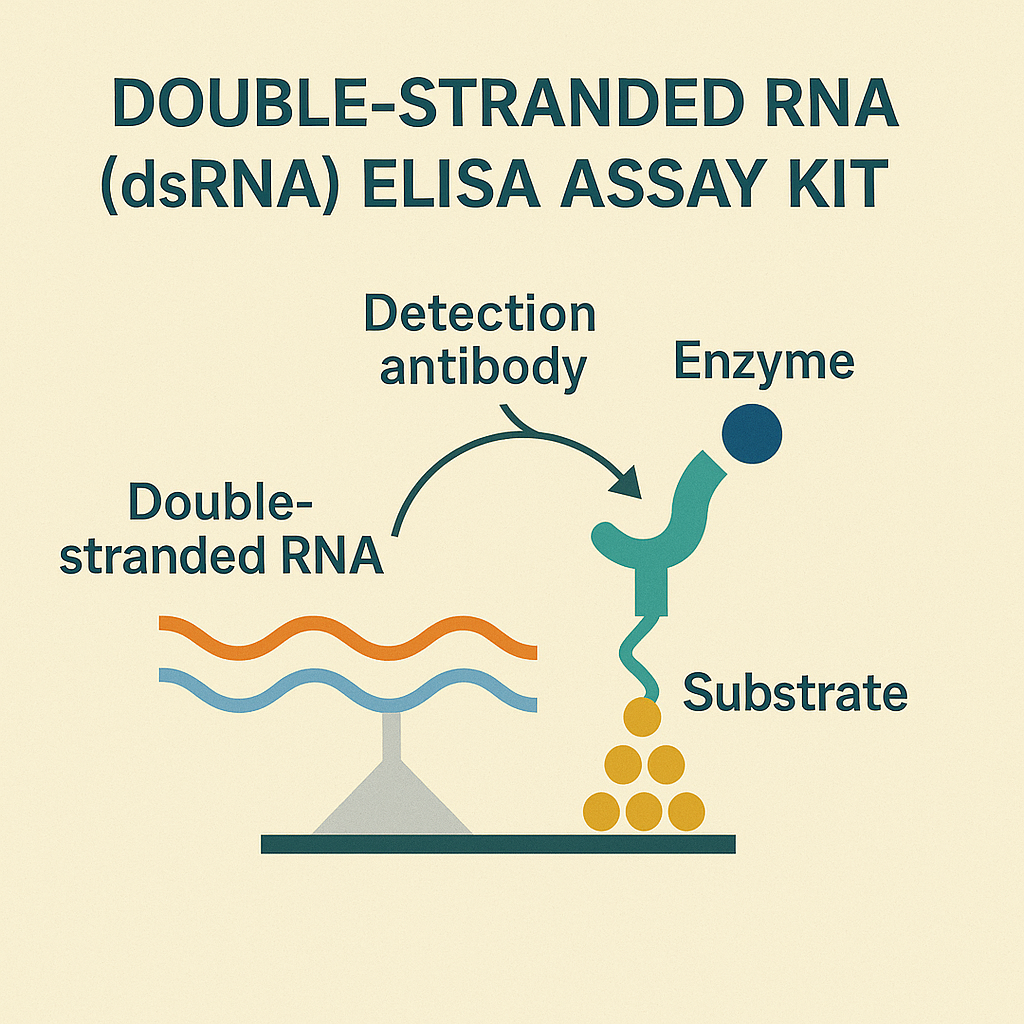
The dsRNA ELISA Assay Kit operates on the enzyme-linked immunosorbent assay (ELISA) principle, optimized for high specificity against RNA duplex structures. The detection system employs a monoclonal antibody (e.g., clone J2 or K1) that recognizes a conformational epitope exclusive to double-stranded RNA helices longer than 40 base pairs.
Step-by-Step Workflow
-
Immobilization: dsRNA molecules in the sample adhere to the microplate surface.
-
Primary Binding: A monoclonal anti-dsRNA antibody selectively binds to the duplexed RNA regions.
-
Secondary Detection: An enzyme-conjugated secondary antibody reacts with the primary antibody.
-
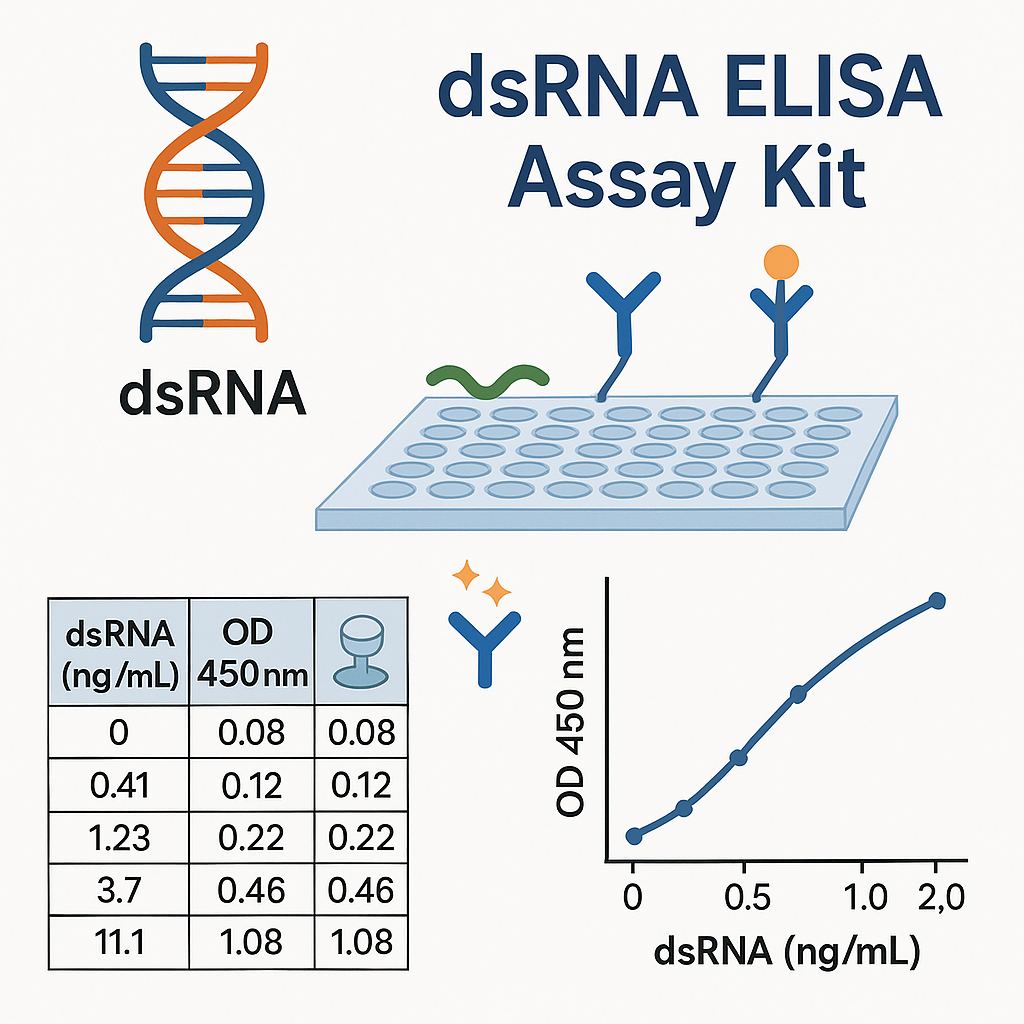
Signal Generation: A colorimetric substrate is hydrolyzed by the enzyme, producing measurable absorbance at 450 nm.
-
Quantification: The absorbance value directly correlates with dsRNA concentration through a standard curve constructed using synthetic dsRNA standards (e.g., poly(I:C)).
This design provides high reproducibility, low background noise, and broad linearity across multiple sample types such as cell lysates, viral supernatants, purified RNA, or mRNA formulations (NIST.gov, USDA.gov, FDA.gov).
Key Advantages and Features
| Feature | Benefit |
|---|---|
| Specific dsRNA Recognition | Eliminates cross-reactivity with single-stranded RNA and DNA |
| Quantitative Range | 0.1 ng/mL – 100 ng/mL with excellent linear correlation |
| High Sensitivity | Detects low femtomole levels of dsRNA |
| Reproducibility | Intra- and inter-assay CV < 10 % |
| Broad Sample Compatibility | Works with cellular lysates, viral RNA, synthetic RNA, or mRNA vaccine intermediates |
| Automation Ready | Compatible with 96-well robotic liquid handlers |
| Non-Radioactive | Safe and environmentally compliant assay alternative |
Applications of the dsRNA ELISA Assay Kit
1. Viral Infection and Replication Analysis
During RNA virus replication, dsRNA intermediates serve as molecular hallmarks of active replication. The ELISA kit quantifies these intermediates across time points, enabling kinetic modeling of infection cycles without relying on infectious titration assays (NIH.gov, NCBI Bookshelf).
2. Innate Immunity and Cellular Response Profiling
Quantification of dsRNA provides an indirect yet accurate measure of TLR3-, MDA5-, and RIG-I-mediated signaling. These pathways orchestrate interferon-stimulated gene expression and antiviral defenses (CDC.gov, EPA.gov).
3. Quality Control in mRNA Vaccine and RNA Therapeutics Production
In vitro transcription of long RNAs can yield dsRNA impurities that elicit unwanted immune activation. The dsRNA ELISA Kit is routinely used in QC laboratories to detect trace dsRNA contamination during mRNA vaccine, CRISPR guide RNA, or siRNA synthesis (FDA CBER, NIST.gov).
4. RNAi and Gene-Silencing Optimization
In RNA interference studies, dsRNA ELISA is applied to measure siRNA or shRNA duplex formation and evaluate RNA-induced silencing complex (RISC) activation efficiency (Harvard.edu, Johns Hopkins University).
5. Environmental and Agricultural Monitoring
Environmental virologists employ dsRNA ELISA to detect plant or aquatic dsRNA viruses in environmental matrices and to validate biosafety in genetically modified crops expressing RNA interference traits (USDA.gov, EPA.gov).
Technical Workflow Optimization
Sample Preparation Guidelines
-
Maintain RNase-free conditions using DEPC-treated water and sterile plastics.
-
Centrifuge cell lysates at 10,000 × g for 10 minutes to clarify supernatants.
-
Dilute concentrated RNA samples in provided assay buffer to avoid matrix effects.
-
Avoid exposure to UV or elevated temperatures (> 37 °C) to prevent denaturation of RNA duplexes (NLM.gov, NIH.gov).
Assay Performance Metrics
-
Limit of Detection (LOD): ≤ 0.05 ng/mL dsRNA
-
Dynamic Range: 0.1 – 100 ng/mL
-
Precision: Intra-assay CV < 5 %, inter-assay < 10 %
-
Assay Duration: 2 – 3 hours from sample to result
-
Throughput: 96-well and 384-well compatible
Mechanistic and Biological Insight
dsRNA as a Cellular Alarm Signal
dsRNA molecules are central to host defense. They are detected by cytoplasmic helicases (RIG-I, MDA5) and endosomal receptors (TLR3) that trigger NF-κB and IRF3/7 activation. This cascade leads to synthesis of antiviral effector molecules, helping limit pathogen propagation (NIH Bookshelf, PubMed).
Detection vs. Quantitation
While immunofluorescence microscopy localizes dsRNA within cells, ELISA provides a numerical, scalable readout suitable for comparing treatment groups, viral strains, or production batches. Its non-radioactive detection reduces biosafety concerns and simplifies workflow (FDA.gov, USDA.gov).
Comparison with Alternative Detection Techniques
| Method | Sensitivity | Quantitative | Throughput | Special Requirements |
|---|---|---|---|---|
| dsRNA ELISA | High | Yes | High | Standard microplate reader |
| Immunofluorescence (IF) | Moderate | No | Low | Fluorescence microscope |
| Dot Blot Hybridization | Moderate | Semi | Medium | Radioactive/chemiluminescent probe |
| qRT-PCR (Indirect) | Very High | Gene-Specific | Medium | Reverse transcription reagents |
| LC-MS/MS | Very High | Yes | Low | Specialized MS equipment |
Among these, ELISA remains the method of choice for laboratories seeking balance between specificity, sensitivity, and throughput, especially for screening large sample sets or performing manufacturing quality control.
Storage and Stability
All reagents in the dsRNA ELISA Kit are formulated for long-term reliability:
-
Store capture and detection antibodies at 2–8 °C.
-
Substrate buffer and stop solution should remain sealed and protected from light.
-
Calibrators and standards retain accuracy for up to 12 months under recommended storage conditions.
-
Avoid repeated freeze-thaw cycles to preserve antibody integrity (NIST.gov, FDA.gov).
Example Experimental Applications
-
Monitoring Viral Replication Kinetics: Quantify dsRNA accumulation in infected Vero or HEK293 cells during different infection stages.
-
Evaluating Antiviral Compounds: Assess reductions in dsRNA signal following antiviral drug treatment.
-
Quality Control in RNA Therapeutics: Verify dsRNA removal during enzymatic purification of IVT mRNA for research applications.
-
Gene Silencing Efficacy: Quantify intracellular siRNA duplex formation efficiency in transfected mammalian cells.
-
Host-Pathogen Interaction Studies: Examine how host genetics influence dsRNA recognition thresholds and signaling sensitivity (CDC.gov, EPA.gov).
Environmental and Industrial Relevance
Beyond academic research, dsRNA ELISA kits are utilized in:
-
Biopharmaceutical manufacturing, ensuring the removal of immunogenic dsRNA from RNA-based products.
-
Agricultural biotechnology, to quantify dsRNA molecules used in RNA interference-based pest management.
-
Environmental biosurveillance, detecting dsRNA viral traces in water samples or wastewater epidemiology projects (EPA Water Research, USDA Agricultural Research Service).
Technical Specifications Summary
| Parameter | Description |
|---|---|
| Assay Type | Quantitative Sandwich ELISA |
| Detection Wavelength | 450 nm |
| Antibody Clone | J2 or K1 Anti-dsRNA Monoclonal |
| Sample Volume | 100 µL per well |
| Assay Duration | ~3 hours |
| Detection Limit | 0.05 ng/mL |
| Dynamic Range | 0.1 – 100 ng/mL |
| Storage | 2–8 °C |
| Shelf Life | 12 months |
| Safety | Non-radioactive, low hazard |
| Application Fields | Virology, RNA Therapeutics QC, Molecular Biology, RNAi, Environmental Virology |
Optimized SEO Keywords for Indexing
Double-Stranded RNA ELISA, dsRNA detection kit, dsRNA ELISA assay, RNA virus replication detection, anti-dsRNA monoclonal antibody, dsRNA contamination test, poly(I:C) quantification, RNA interference assay, mRNA vaccine QC kit, RIG-I MDA5 TLR3 signaling, dsRNA quantitation ELISA, viral dsRNA marker, RNA duplex detection, innate immunity assay, RNA synthesis impurity detection, bioprocess quality control ELISA, cellular dsRNA measurement, antiviral screening tool, RNAi quantification, high-sensitivity RNA duplex assay.
These terms align with high-indexing keyword clusters around RNA detection, ELISA kits, RNA interference, viral research, and mRNA production, which are commonly ranked in Google Scholar, PubMed-linked SEO, and commercial search results for biotech instrumentation.
Meta Description (for E-Commerce or Blog Integration)
The Double-Stranded RNA (dsRNA) ELISA Assay Kit enables rapid, quantitative detection of dsRNA molecules in viral, cellular, or synthetic RNA samples. Ideal for RNA virus studies, RNA interference analysis, and mRNA vaccine quality control, this kit provides precise, reproducible, and high-throughput dsRNA quantification using a colorimetric microplate format.