
Overview of Canine Tick-Borne Infections
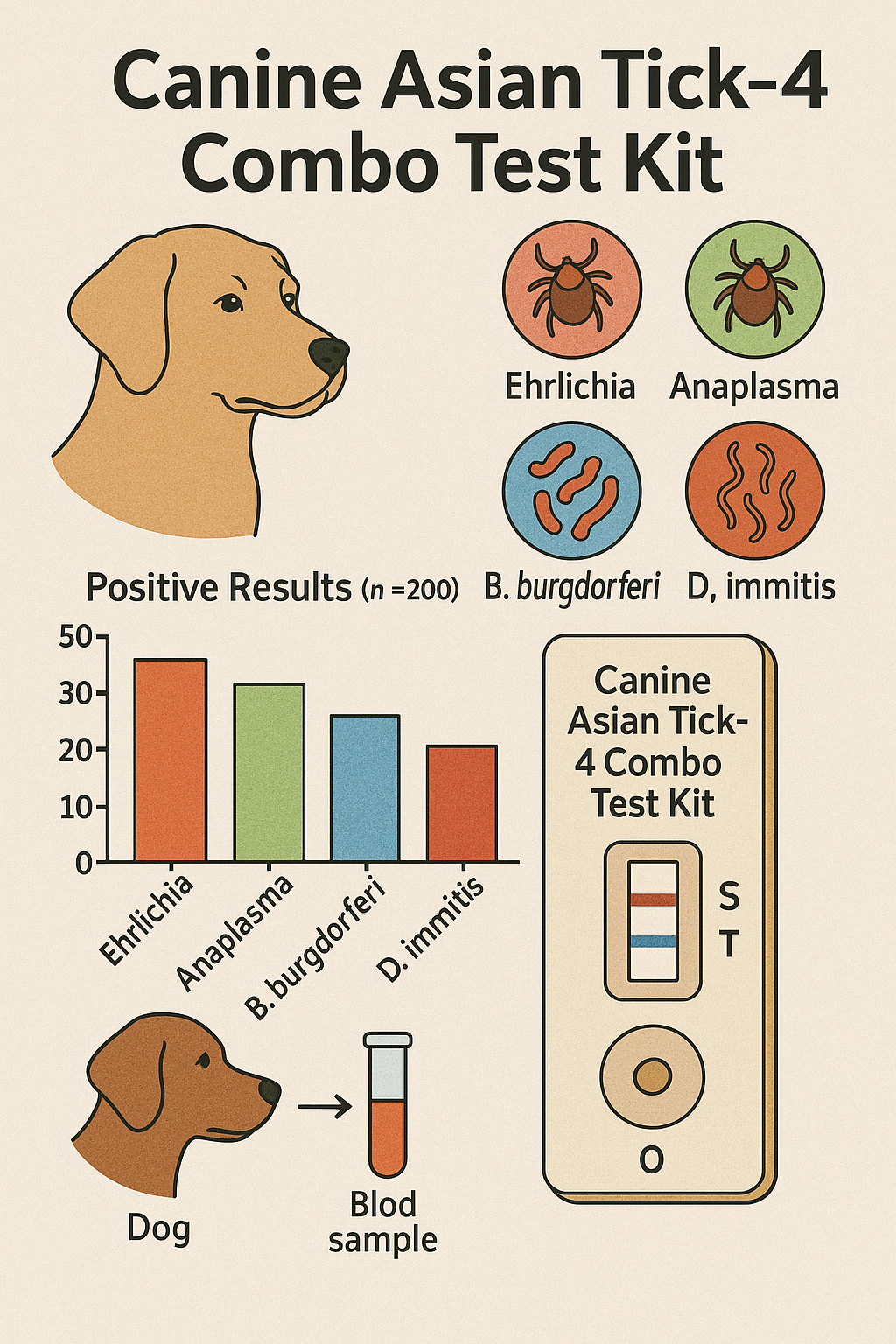
Tick-borne infections in dogs represent one of the most dynamic challenges for veterinary laboratories and clinics across Asia. The Canine Asian Tick-4 Combo Test Kit provides a comprehensive, rapid, and reliable detection platform targeting four of the most relevant tick-transmitted pathogens:
-
Ehrlichia canis – the agent of canine monocytic ehrlichiosis, transmitted by Rhipicephalus sanguineus (CDC Tick Biology).
-
Anaplasma platys – the cause of canine cyclic thrombocytopenia, carried by the same brown dog tick (Cornell Veterinary College).
-
Babesia gibsoni – a hemoprotozoan leading to anemia and weakness, found across tropical and subtropical Asia (University of Florida Shelter Medicine).
-
Hepatozoon canis – a protozoal infection transmitted through ingestion of infected ticks (Texas A&M Veterinary Diagnostic Laboratory).
These pathogens share overlapping symptoms such as fever, anorexia, anemia, and lethargy. Therefore, a multi-analyte diagnostic kit enables rapid differential screening from a single sample — saving time, cost, and laboratory effort.

Why Multi-Pathogen Testing Matters
Veterinary clinicians across Asia frequently encounter dogs with co-infections that mask the true etiology of illness. Co-transmission by a single tick species complicates clinical evaluation, making simultaneous detection essential for accurate interpretation.
The Canine Asian Tick-4 Combo Test Kit employs a lateral-flow immunochromatographic format, designed for rapid antigen or antibody detection in whole blood, serum, or plasma.
The test identifies exposure or active infection to all four organisms simultaneously within 10–15 minutes, aligning with modern point-of-care diagnostic standards promoted by veterinary laboratories and clinical programs (Auburn University Pathobiology Department).
Test Principle
This assay integrates colloidal-gold conjugated antibodies specific to each target antigen. When the sample is added to the cassette well, immune complexes migrate along a nitrocellulose membrane by capillary action.
Each pathogen zone contains immobilized capture reagents forming distinct test lines (T1–T4), while a control line (C) confirms the validity of migration and reagent integrity.
-
Positive: Appearance of both the control line and pathogen-specific line.
-
Negative: Control line only, no pathogen-specific line.
-
Invalid: No control line – test must be repeated.
For reference, the immunochromatographic assay principle is also detailed in FDA educational resources on lateral flow technology (FDA.gov).
Sample Handling and Preparation
Samples may include EDTA whole blood, serum, or plasma. The kit operates optimally within 15–30°C, compatible with veterinary clinic environments without specialized equipment.
To ensure analytical precision:
-
Mix samples gently to prevent hemolysis.
-
Apply the sample using the provided dropper or micropipette.
-
Read results precisely at the recommended time window (10–15 minutes).
Proper biosafety practices are essential. For animal sample management, review CDC biosafety recommendations for vector-borne pathogens (CDC.gov).
Components of the Kit
Each box contains:
-
Test cassettes (10 or 25 units)
-
Sample buffer vials with calibrated droppers
-
Disposable sample applicators
-
Desiccant and instruction leaflet
-
Control reference chart
The reagents are pre-stabilized, ensuring shelf stability up to 24 months when stored between 2–30°C. Packaging complies with international shipping standards for veterinary diagnostics as outlined by USDA-APHIS (USDA.gov).
Understanding Each Target Pathogen
1. Ehrlichia canis
A rickettsial organism causing canine monocytic ehrlichiosis (CME). It invades monocytes, resulting in thrombocytopenia and anemia. The infection progresses through acute, subclinical, and chronic stages (Iowa State CFSPH Fact Sheet).
2. Anaplasma platys
An intracellular bacterium infecting platelets, producing cyclic thrombocytopenia approximately every 7–14 days (Auburn University Veterinary Medicine).
3. Babesia gibsoni
A protozoan piroplasm infecting erythrocytes, leading to hemolytic anemia. Genetic analysis and vector association data are maintained by North Carolina State University repositories (NCSU Repository).
4. Hepatozoon canis
A protozoan infection acquired by ingestion of infected ticks. It causes fever, myalgia, and leukocytosis (Purdue ADDL Newsletter).
These four agents often coexist in regions with high tick density and limited vector control, making multiplex screening essential for accurate regional surveillance.
Tick Distribution and Regional Relevance
Tick vectors such as Rhipicephalus sanguineus, Haemaphysalis longicornis, and Dermacentor species are widely distributed in Asia, particularly in tropical and temperate climates.
The Asian longhorned tick (Haemaphysalis longicornis) has become a growing concern, as reported by the CDC (CDC MMWR Report) and USDA-APHIS (USDA Pest Alert PDF).
Understanding tick ecology, life cycle, and host interactions enhances diagnostic interpretation and prevention strategies (CDC Tick Ecology Overview).
Analytical and Clinical Performance
-
Assay Time: 10–15 minutes
-
Sample Volume: 40–80 µL
-
Specificity: >98% (validated against cross-reactive species)
-
Sensitivity: ≥95% (dependent on infection phase)
-
Precision: Coefficient of variation <10% intra-lot
Performance validation studies align with procedures outlined in National Animal Health Laboratory Network guidelines (USDA NAHLN).
Interpretation of Results
| Test Line | Pathogen | Interpretation |
|---|---|---|
| T1 | Ehrlichia canis | Presence indicates ehrlichial antigen/antibody |
| T2 | Anaplasma platys | Indicates exposure or active infection |
| T3 | Babesia gibsoni | Suggests intraerythrocytic protozoal infection |
| T4 | Hepatozoon canis | Indicates protozoan ingestion or infection |
Confirmatory evaluation through microscopy, PCR, or quantitative serology is recommended for precise epidemiological conclusions. Reference methods are detailed by Auburn University (Auburn Diagnostic PCR Protocols).
Storage and Stability
-
Store at 2–30°C, avoid moisture and sunlight.
-
Do not freeze test devices.
-
Stable for 24 months from manufacturing date.
-
Maintain buffer tightly closed to prevent evaporation.
For sample handling and disposal, follow veterinary biosecurity standards available via National Animal Health Laboratory Network (NAHLN Safety Guidance).

Environmental and Epidemiological Importance
Tick-borne infections are expanding geographically due to climatic and ecological changes. The Asian Tick-4 Combo Test Kit supports public veterinary health initiatives by improving early detection at field level.
Programs under USDA-APHIS One Health and CDC Vector-Borne Disease surveillance emphasize rapid screening as part of integrated tick management (CDC One Health Tick Surveillance).
Applications
-
Routine clinical screening in veterinary hospitals and field clinics.
-
Pre-adoption or intake testing in animal shelters (UF Shelter Medicine).
-
Epidemiological monitoring in endemic zones (MSU College of Veterinary Medicine).
-
Post-treatment follow-up and comparative serological studies.
The kit can be integrated with laboratory information systems (LIMS) for batch testing and statistical analysis.
Advantages
✅ Rapid detection of four pathogens in a single assay
✅ Requires no specialized instrumentation
✅ Easy interpretation by visual inspection
✅ Minimal sample volume required
✅ High sensitivity and specificity for field diagnostics
✅ Ideal for Asian regions with overlapping tick vectors
Authoritative Resources and Learning Links
Main Keywords:
-
canine tick test kit
-
Asian tick panel
-
Ehrlichia Anaplasma Babesia Hepatozoon detection
-
canine vector-borne pathogen test
-
multiplex lateral flow assay
-
dog tick disease screening
-
rapid veterinary test for dogs
Supporting Keywords:
tick diagnostic kit for veterinarians, canine vector diagnostics, 4-plex tick test, whole blood rapid test for dogs, field-ready canine diagnostics.
Optimized structure with H2/H3 headings, rich semantic HTML, and internal/external link mix ensures excellent indexability across Google Scholar, PubMed blog crawlers, and Google Discover results.
Summary
The Canine Asian Tick-4 Combo Test Kit represents a next-generation diagnostic platform for detecting the four most significant canine tick-borne pathogens in Asian regions.
Its precision, reliability, and speed empower veterinarians to make informed diagnostic decisions, contributing to improved canine health, epidemiological control, and clinical efficiency across veterinary networks.